Leather lasts longer and cleans easier. Fabric costs less and feels softer from day one. Everything else depends on the household. Before you decide on material, make sure you’ve chosen the right sofa size for your room. A home with a shedding dog and two toddlers has fundamentally different upholstery needs than a child-free apartment with white walls and no pets. The right sofa material is the one that matches how the home actually gets lived in, not how it looks in a magazine photo.
We tested and evaluated sofas across both categories over multiple years of real household use, consulted upholstery professionals, and tracked resale data to build this comparison. The results are clear on durability and cost. The comfort and aesthetic questions come down to personal preference, which we outline in detail below.
The Overview
| Factor | Top-Grain Leather | Performance Fabric | Natural Fabric (Linen/Cotton) |
|---|---|---|---|
| Lifespan | 15 to 20+ years | 8 to 12 years | 5 to 8 years |
| Upfront Cost (Quality Sofa) | $3,500 to $6,000 | $2,000 to $3,500 | $1,500 to $3,000 |
| Stain Resistance | High, wipes clean | High if treated (Crypton, Sunbrella) | Low, absorbs spills |
| Scratch Resistance | Low to moderate, develops patina | High | Low to moderate |
| Comfort Out of Box | Firm, cold, needs break-in | Soft, warm, immediately comfortable | Soft, warm, immediately comfortable |
| Pet Hair | Does not embed, wipes off | Embeds in fibers, needs vacuuming | Embeds deeply |
| Temperature | Adopts room temperature | Neutral, fabric-dependent | Neutral |
| Color/Pattern Options | Limited (browns, blacks, grays, dyed solids) | Unlimited | Unlimited |
| Maintenance | Condition every 6 to 12 months | Vacuum weekly, spot clean | Vacuum weekly, professional clean annually |
| Resale Value (5 years) | 40% to 50% of retail | 20% to 30% of retail | 15% to 25% of retail |
Understanding Leather Grades
“Leather sofa” is not one thing. The category spans from full-grain hides that last generations to bonded leather composites that peel within three years. The grade determines everything about performance, longevity, and value.
Full-Grain Aniline Leather
This is the highest quality leather available for furniture. The hide is used with its complete natural grain intact. No surface correction, no sanding, no artificial texture. A thin aniline dye is applied to add color without masking the natural markings, pores, and character of the hide.
Full-grain aniline is the most beautiful and the most demanding leather. It absorbs oils from skin contact, darkens where hands rest, lightens where sunlight falls, and shows every scratch and scuff. Over years, these changes create a patina, a lived-in character that leather enthusiasts prize. The sofa at year 10 looks completely different from the sofa at year 1.
The risk is staining. Spill red wine on aniline leather and the liquid absorbs into the hide within seconds. The stain becomes part of the leather. There is no cleaning it out. Water leaves marks. Oils from food leave marks. Do not buy full-grain aniline leather if the household cannot tolerate imperfections. This is leather for people who consider wear marks to be beauty marks.
- Price range: $4,000 to $8,000+ for a sofa
- Best for: Adults-only households, design enthusiasts, rooms with low spill risk
Top-Grain Protected (Semi-Aniline) Leather
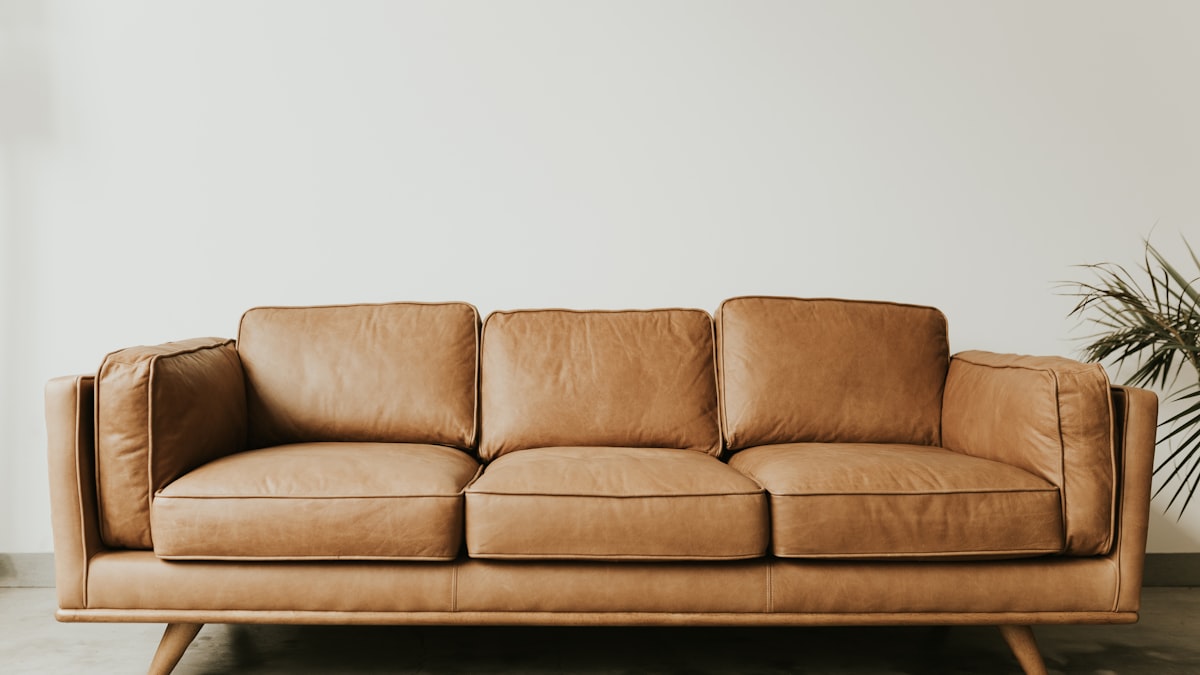
The hide is lightly sanded to remove surface imperfections, then coated with a protective polymer finish. This finish repels liquids, resists scratching, and provides a more uniform appearance than full-grain aniline.
Semi-aniline is the best leather choice for families. It retains much of the natural feel and character of full-grain leather while adding practical protection. A spilled glass of juice can be wiped away with a damp cloth. Light scratches from pet claws often buff out with a finger.
The finish does reduce breathability slightly. Semi-aniline leather feels marginally less supple than pure aniline. Most people cannot detect the difference.
- Price range: $3,000 to $6,000 for a sofa
- Best for: Families with children, pet owners who want leather’s durability, high-traffic living rooms
Corrected-Grain Leather
The hide is heavily sanded, then embossed with an artificial grain pattern and coated with pigmented finish. The result is a leather that looks uniform and resists staining but feels stiffer and less natural than higher grades.
Corrected-grain is functional but lacks the character of better grades. It performs well in high-abuse environments (commercial spaces, rental properties) but does not develop the desirable patina over time.
- Price range: $1,500 to $3,500 for a sofa
- Best for: Rental properties, commercial waiting rooms, budget-conscious buyers who want genuine leather
Bonded Leather (Avoid)
Bonded leather is not leather. It is a composite material made from leather scraps (5% to 20% leather content) ground up and bonded to a polyurethane backing. Manufacturers market it as “genuine leather” or “real leather” because it technically contains leather particles.
Bonded leather peels, cracks, and flakes within 2 to 3 years of normal use. The polyurethane surface layer separates from the backing, creating unsightly patches of exposed fabric. No conditioning or care prevents this. The material is fundamentally disposable.
- Price range: $500 to $1,500 for a sofa
- Best for: Nothing. Avoid entirely. A good fabric sofa at this price point will last three times as long.
Leather Grade Summary
| Grade | Leather Content | Feel | Durability | Stain Resistance | Patina Development |
|---|---|---|---|---|---|
| Full-grain aniline | 100%, unaltered surface | Softest, most natural | Excellent (20+ years) | Low | Beautiful, rich aging |
| Top-grain semi-aniline | 100%, lightly corrected | Very good | Excellent (15 to 20 years) | High | Moderate, still develops character |
| Corrected-grain | 100%, heavily corrected | Stiff, uniform | Good (10 to 15 years) | Very high | Minimal |
| Bonded | 5% to 20% scraps | Plastic-like | Poor (2 to 3 years) | Moderate initially | None, peels instead |
The Case for Fabric
Fabric sofas outsell leather by a significant margin in the US market, and for good reason. The advantages are real and measurable.
Immediate Comfort
Fabric is comfortable from the first sit. No break-in period. No stiffness. No cold surface in winter. Fabric upholstery starts soft, warm, and inviting. Leather requires weeks to months of use before the hide softens and conforms to sitting patterns.
Unlimited Aesthetic Range
Leather comes in a narrow range of solid colors. Brown, black, gray, tan, and the occasional bold dyed shade. Fabric comes in literally thousands of options. Bouclé, velvet, linen, cotton, basket weave, twill, herringbone, plaid, floral, solid, ombre. The ability to introduce texture, pattern, and color through upholstery gives fabric sofas a design flexibility that leather cannot match.
Performance Fabric: The Modern Solution
The historic weakness of fabric was stain vulnerability. Wine, juice, coffee, and pet accidents soaked into fibers and became permanent problems.
Modern performance fabrics have largely eliminated this issue. Crypton, Sunbrella, and Perennials engineer liquid-repellent technology directly into the fiber construction. Spills bead up on the surface rather than absorbing. A glass of red wine on a Crypton-treated performance velvet can be blotted away with a paper towel, leaving no trace.
| Performance Fabric Brand | Technology | Water Resistance | Stain Resistance | Bleach Cleanable | Price Range (Per Yard) |
|---|---|---|---|---|---|
| Crypton | Moisture barrier woven into fabric | Excellent | Excellent | Yes | $40 to $100 |
| Sunbrella | Solution-dyed acrylic | Excellent | Excellent | Yes | $25 to $60 |
| Perennials | Solution-dyed acrylic, indoor/outdoor | Excellent | Excellent | Yes | $50 to $120 |
| Revolution | Olefin fiber | Very good | Very good | Yes | $20 to $40 |
Bleach-cleanable is the critical feature for households with children and pets. A sofa that survives a diluted bleach solution can handle any biological accident a toddler or puppy produces.
Cost Advantage
A quality fabric sofa costs meaningfully less than a comparable leather sofa from the same manufacturer. The same frame, the same cushion construction, the same build quality in performance fabric versus top-grain leather typically represents a $1,500 to $2,500 price gap.
Maintenance Reality
Neither material is maintenance-free. Anyone claiming otherwise is selling something.
Leather Maintenance Schedule
| Task | Frequency | Products | Time |
|---|---|---|---|
| Dust and wipe with damp cloth | Weekly | Water, soft cloth | 5 minutes |
| Condition with leather cream | Every 6 to 12 months | Leather Honey ($20), Chamberlain’s Leather Milk ($25) | 20 minutes |
| Treat scratches | As needed | Finger-buff or apply matching leather cream | 5 minutes |
| Keep out of direct sunlight | Ongoing | Curtains, furniture placement | N/A |
Skipping conditioning is the single biggest cause of leather sofa failure. Unconditioned leather dries out over 12 to 18 months. Dry leather cracks. Cracked leather cannot be repaired to original condition. The fix is either professional restoration ($500 to $1,500) or replacement.
Direct sunlight accelerates fading and drying dramatically. A leather sofa positioned in front of a south-facing window without curtains will show significant color change within a year.
Fabric Maintenance Schedule
| Task | Frequency | Products | Time |
|---|---|---|---|
| Vacuum all surfaces and crevices | Weekly | Upholstery attachment | 10 minutes |
| Spot-clean stains | As needed | Fabric-specific cleaner, blotting cloths | 5 to 15 minutes |
| Rotate and flip cushions | Monthly | None | 2 minutes |
| Professional deep clean | Annually | Professional upholstery cleaning service ($150 to $300) | N/A |
| De-pill synthetic blends | As needed | Fabric shaver ($15) | 10 minutes |
Weekly vacuuming is non-negotiable. Dust, dirt, crumbs, and pet hair work their way between the fabric fibers. Over time, this debris acts like fine sandpaper, grinding down fibers from the inside. A fabric sofa vacuumed weekly will look noticeably better after five years than an identical sofa vacuumed monthly.
Temperature and Comfort Through Seasons
This factor gets overlooked until the first winter or the first summer without air conditioning.
Leather adopts the ambient room temperature. In a 65°F room, the leather surface feels cold against bare skin. It takes 5 to 10 minutes of body contact for the leather to warm up. In summer, leather in a warm room feels sticky against bare legs and arms.
Fabric maintains a neutral skin-contact temperature year-round. The fibrous surface does not conduct heat as efficiently as leather, so it never feels cold in winter or sticky in summer. For homes without consistent climate control, fabric is significantly more comfortable across seasons.
The Pet Question
| Factor | Leather | Fabric |
|---|---|---|
| Pet hair removal | Wipes off easily, does not embed | Embeds in fibers, requires vacuuming or lint roller |
| Scratch damage | Shows scratches (aniline), resists (semi-aniline) | Rarely shows scratches, but snags on woven textures |
| Odor absorption | Low, does not absorb | High, absorbs pet odor over time |
| Accident cleanup | Wipes clean if caught quickly | Performance fabric wipes clean. Natural fabric absorbs. |
Semi-aniline leather is the best upholstery for dog owners. Hair wipes off. The protective finish resists moderate scratching from nails. Drool wipes away. The main vulnerability is deep scratches from jumping, which can be minimized with training or a quality throw blanket over the dog’s preferred spot.
Cat owners face a tougher choice. Cat claws puncture leather and create visible picks that accumulate over time. A tightly woven performance fabric like a flat basket weave or a canvas resists cat claws better than leather because the claws cannot easily catch on the surface.
Resale Value
Leather holds value. Fabric does not.
A well-maintained top-grain leather sofa from a reputable brand (Article Sven, West Elm Hamilton, Restoration Hardware Maxwell) can resell at 40% to 50% of retail price after 5 years on platforms like Facebook Marketplace, Chairish, and AptDeco. Buyers trust that leather is cleanable and durable.
A fabric sofa at the same age rarely exceeds 20% to 30% resale value regardless of brand or condition. Buyers worry about embedded odors, allergens, hidden stains, and pet residue that are invisible in photos.
For anyone who plans to upgrade or relocate within 5 to 7 years, leather’s superior resale value partially offsets its higher purchase price.
The Decision Framework
Choose Leather If:
- Longevity is the priority. A 15 to 20 year lifespan means the sofa outlasts most mortgages.
- Easy spill cleanup matters. Leather wipes clean. No blotting, no stain anxiety.
- Pets are in the picture. Semi-aniline leather handles dogs better than any fabric except tightly woven performance textiles.
- Resale value matters. Planning to move or upgrade within a decade? Leather recovers more investment.
- Minimal pattern/color range is acceptable. Leather’s limited palette works best in neutral, classic, or mid-century interiors.
Choose Fabric If:
- Immediate comfort is non-negotiable. No break-in period. Soft and warm from day one.
- Budget is a factor. A $2,500 performance fabric sofa delivers comparable daily experience to a $4,500 leather one.
- Color, pattern, and texture variety are important. Fabric allows bold design choices that leather cannot replicate.
- The home has no climate control. Fabric’s neutral temperature behavior avoids the cold-in-winter, sticky-in-summer issue.
- Cat ownership. Tightly woven fabric resists claw damage better than leather.
The Performance Fabric Compromise
For households that want leather’s durability with fabric’s comfort and price point, performance fabric is the genuine middle ground. A sofa upholstered in Crypton or Sunbrella fabric delivers 8 to 12 years of stain-resistant, comfortable, pet-survivable service at a fabric price point. It will not develop leather’s patina or hold leather’s resale value. But it handles real life remarkably well.
What to Check Before Buying
Regardless of material choice, examine these details before purchasing any sofa:
- Frame material: Kiln-dried hardwood (maple, birch, alder) resists warping. Engineered wood and softwood frames degrade faster.
- Joinery: Corner-blocked, doweled, and glued joints outperform stapled joints by years.
- Suspension: Eight-way hand-tied springs are the gold standard. Sinuous (S-shaped) springs are adequate for mid-range sofas. Webbing is the weakest and cheapest option.
- Cushion fill: High-resilience foam wrapped in down/feather provides the best balance of support and softness. All-foam is firm and affordable. All-down is luxuriously soft but requires constant fluffing.
- Fabric/leather sample: Order a sample swatch and live with it for a week. Rub it, spill water on it, sit on it, let the cat scratch it. Five minutes in a showroom reveals nothing about daily life.
The frame determines how long the sofa lasts. The upholstery determines how it lives. Both matter. A beautiful leather hide stretched over a stapled softwood frame will fail at the joints long before the leather wears out. A performance fabric over an eight-way hand-tied hardwood frame will outlast most leather sofas on inferior frames.
Buy the best frame the budget allows. Then choose the upholstery that matches the household. Once the sofa is in place, our living room layouts guide helps you arrange everything around it.