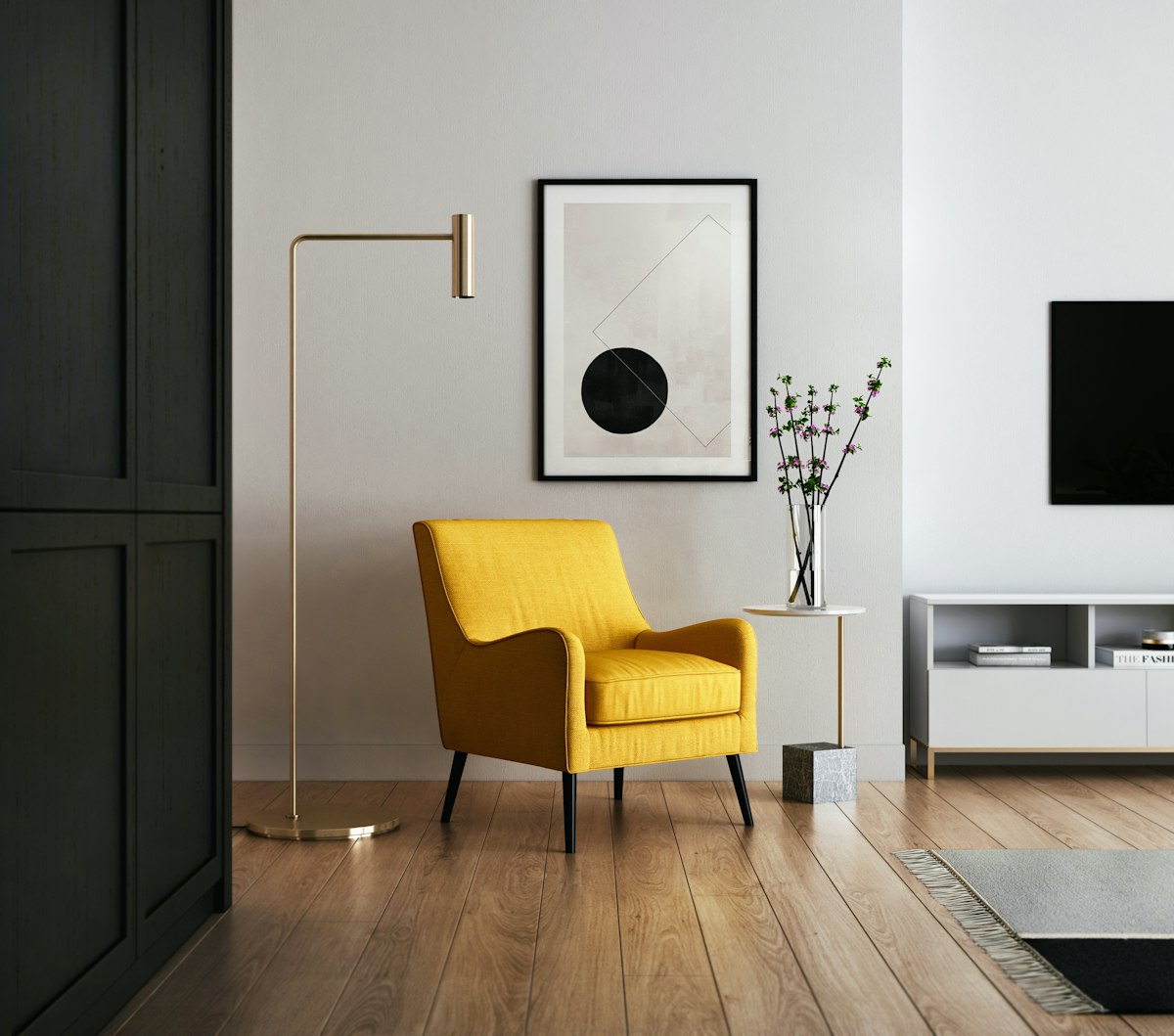
The TV presents a genuine design problem that most interior design advice glosses over. When it is on, it is fine: a bright display that fills the room with content. When it is off, it is a large black rectangle on the wall with no visual contribution. The room needs to work in both states.
The most common mistake is treating the TV wall as a problem to solve by surrounding the screen with enough objects that the viewer stops noticing the dark rectangle. This approach fails because it produces clutter rather than composition, and because a busy arrangement of objects around a screen creates visual competition when the screen is on.
The correct approach is different: design the TV wall as a considered composition where the television is one element among several, not the focal point that everything else serves.
Start with the Screen Position
Most TVs are mounted too high. The industry standard advice is to mount the screen so the center is at seated eye level, approximately 42–45 inches from the floor for average seating height. Many homeowners mount significantly higher, which creates neck strain and makes the TV appear to be addressing the ceiling rather than the room.
The TV should be on or near a piece of furniture. A screen floating on a bare wall with nothing beneath it creates a visual problem: the screen has no grounding, no relationship to the floor, and no functional context. A media console, low credenza, or built-in cabinet beneath the screen creates the visual base that makes the entire wall composition legible.
If you are using a media console, see our guide to best TV stands for modern living rooms for options that do not make the situation worse.
The Three Approaches
Approach 1: Symmetrical Flanking
Place identical or closely related elements on either side of the TV at the same height. This creates a horizontal composition that includes the TV as a center element rather than an isolated rectangle.
The most effective flanking elements are:
- Sconces at the same height as the screen’s vertical center, mounted 18–24 inches from the TV’s edge
- Tall potted plants in identical pots flanking the media console
- A pair of framed prints at exactly the same height, centered vertically on the screen
The mistake to avoid in symmetrical flanking is unequal sizing. If one side has a tall plant and the other has a small decorative object, the asymmetry reads as an error rather than a design decision. If you want asymmetry, use it deliberately (Approach 3). Symmetrical flanking requires actual symmetry.
Sconces at screen height serve double duty: they illuminate the wall behind the screen, which reduces eye strain during viewing (the high contrast between a bright screen and a dark wall is harder on the eyes than a lit wall), and they contribute to the composition when the TV is off.
Approach 2: Gallery Wall Integration
A gallery wall that incorporates the TV as one element in a larger composition is the most design-forward approach when executed correctly. The TV becomes part of an intentional arrangement rather than a visual interruption.
The execution requirements are demanding. The gallery elements must be scaled correctly relative to the TV. A 65-inch screen is large, and gallery prints need to be large enough to maintain visual weight alongside it. Gallery arrangements that use 8×10 prints around a 65-inch TV look like they are trying to hide something behind a small cluster of frames.
For a gallery wall arrangement to work around a TV:
- Use at least one print or canvas that is 24×30 inches or larger
- Keep the bottom of all gallery elements at or above the top of the media console
- Leave 3–5 inches of bare wall between the TV edge and the nearest frame
- Use a consistent frame finish (all black, all natural wood, all white) to avoid visual chaos
The gallery arrangement should extend to the same horizontal width as the media console below. A cluster of frames hovering above the TV without relationship to the furniture beneath reads as incomplete.
Approach 3: Deliberate Asymmetry
Place a single strong element on one side of the TV and leave the other side with intentional negative space. A floor lamp at one side, a tall sculptural plant, or a large single-piece artwork hung beside the screen creates asymmetrical balance when the proportions are correctly managed.
The element on the active side should be large enough to hold visual weight against the TV. A small cactus beside a 65-inch screen creates an imbalance that reads as oversight. A 6-foot fiddle leaf fig in a large ceramic pot holds its own.
For single-element asymmetric arrangements:
- The element’s visual center should be at approximately the same height as the TV’s center
- Leave at least 12 inches between the element and the TV edge
- The negative space on the opposite side should be truly empty, no shelves, no art, nothing
Cable Management Is Non-Optional
Every decorating decision around a TV is undermined by visible cable runs. A thoughtfully composed TV wall with multiple HDMI cables dangling from the screen bottom to the floor defeats the composition.
The priority hierarchy for cable management:
-
In-wall cable routing is the cleanest solution. A recessed power kit (approximately $30) routes cables through the wall to an outlet behind the media console, eliminating all visible cable runs. Requires a drill and an hour of work.
-
Cable raceways are the renter alternative. A paintable raceway in the wall color is visible but structured and reads as intentional rather than neglected. Available at hardware stores for under $20.
-
Cable sleeves bundle multiple cables into a single sleeve that runs along the wall edge or behind furniture. Not invisible, but significantly better than individual cable runs.
See our detailed guide on how to hide TV cords and cables for installation instructions for each approach.
Avoid These Common Mistakes
Do not center the TV between two windows. The competing light sources, backlit windows flanking a bright screen, create eye strain and make the wall composition fight itself.
Do not place art directly above the TV. Art above a television will never receive appropriate attention. Viewers’ eyes go to the screen when it is on and to the art awkwardly when it is off. The relationship between the two elements creates visual confusion rather than composition.
Do not use a projector screen if you dislike the blank white screen look. A pull-down projector screen solves the TV-off aesthetic problem (the screen disappears) but creates a new one (the white screen when not in use is also visually intrusive in a different way). Electric retractable screens address both states at a cost of $1,000 or more.
Do not paint the TV wall a different color unless you have a media room. The feature wall behind the TV is a trend that peaked before 2015. It draws attention to the TV-as-focal-point rather than integrating it into the room. The exception is a dedicated home theater or media room where the design intent is explicitly screen-focused.
The Frame TV as a Design Solution
Samsung’s The Frame TV deserves mention because it genuinely changes the TV-off design problem. When off, The Frame displays artwork from an internal library or user-uploaded images, transforming the screen into what reads as a framed print on the wall.
It costs more than a comparable non-Frame TV: approximately $300–$500 premium for the same screen size and resolution. The art subscription is an additional $4.99 per month for access to the full museum-quality library (free content is also available).
It works best in rooms where the TV wall composition is otherwise strong. The Frame TV on a bare wall with no media console is still a floating screen; it just displays art when off. It is not a substitute for the design work described above. It is a complement to it.
Practical Checklist
Before finalizing your TV wall arrangement, confirm:
- TV center is at 42–45 inches from floor (adjust for your actual seating height)
- Media console or built-in provides visual base for the screen
- All cables are routed or concealed before any other decorating decisions
- Flanking or gallery elements are sized appropriately relative to screen size
- No art is positioned directly above the TV
- The arrangement works visually with the TV both on and off