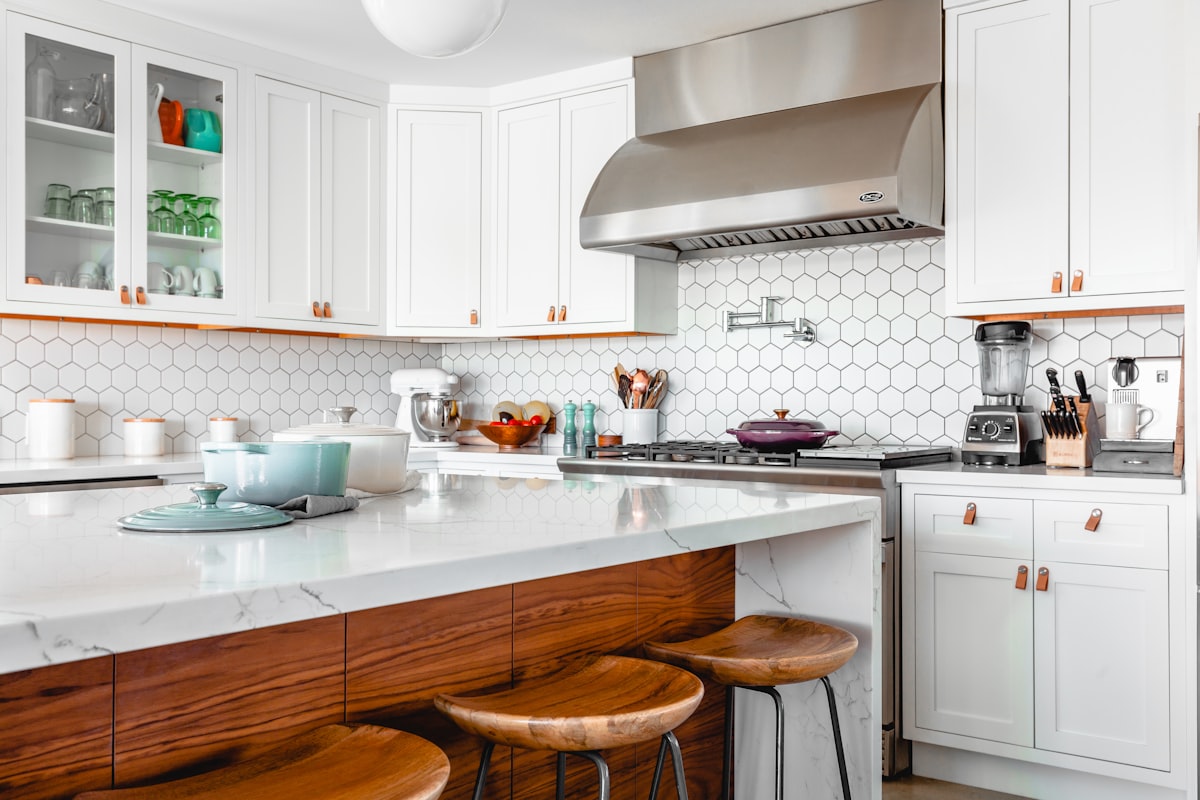
The backsplash is the most directly functional surface in the kitchen. It sits behind the stove and the sink, receives cooking splatter and water daily, and is wiped down more frequently than any other surface in the room. Choosing it on the basis of how it looks in photographs on design accounts misses the more important question: how it performs over years of actual cooking.
The best backsplash for most kitchens is large-format porcelain tile in a satin or matte finish with minimal grout joints. The aesthetic case is real, it reads as calm and deliberate. The functional case is stronger: large tiles mean fewer grout lines to harbor bacteria and cooking residue, and satin-finished porcelain cleans in one pass with a damp cloth.
Everything else in this guide represents legitimate alternatives depending on your priorities and existing kitchen conditions.
Material Options: What Each One Actually Does
Ceramic and Porcelain Tile
The default choice for good reasons. Both are kiln-fired clay products. The functional difference:
Ceramic is fired at lower temperatures and absorbs up to 3% of its weight in water. Adequate for backsplash use because it’s not submerged, but the slight porosity means grease can penetrate unglazed surfaces over time. Use glazed ceramic only.
Porcelain is fired at higher temperatures and absorbs less than 0.5% of its weight. Denser, harder, and more resistant to staining and moisture. The better choice for the area immediately behind the stove.
Large format (12” × 24” / 30 × 60 cm or larger) tile dramatically reduces the number of grout joints. Behind a 36” range with standard installation, subway tile creates roughly 180 grout joints. A large-format layout creates fewer than 20. Each grout joint is a trap for cooking residue.
Subway tile (3” × 6” / 7.5 × 15 cm) remains the most common backsplash choice. It is not wrong. It reads as clean and neutral. The maintenance trade-off is the grout: horizontal grout lines behind the stove collect steam residue and must be scrubbed rather than wiped. A darker grout color (charcoal, warm gray) conceals this better than white.
Natural Stone
Marble, travertine, and slate add genuine material depth and character. The functional trade-offs are significant.
Marble is porous and reactive to acids. Tomato sauce, lemon juice, and vinegar-based cleaners etch the surface, permanently removing the polish in the affected area. For a backsplash, marble requires prompt cleanup of acidic spills (measured in minutes, not hours) and annual sealing. For a cooking-forward kitchen, this is an ongoing requirement rather than a one-time decision. The maintenance commitment is real, not a footnote.
Honed marble (matte finish) hides etching better than polished because the surface already reads as soft and diffuse. If you want marble in a kitchen that’s actually used for cooking, honed is the more forgiving finish.
Travertine has natural voids in its structure that must be filled before installation. Filled and sealed travertine performs adequately as a backsplash. Unsealed or poorly filled travertine traps cooking grease in the voids and is very difficult to clean.
Slate is naturally cleft (uneven surface), water-resistant when sealed, and produces a dark, matte, textural effect no tile replicates. The uneven surface means more surface area for cleaning, but its natural oils resist typical kitchen soils reasonably well.
For more detail on how stone materials compare across kitchen applications, our granite vs quartz countertop guide covers heat resistance and porosity in depth, the same principles apply at smaller scale to stone backsplash.
Glass Tile
Glass tile is non-porous and stain-proof. Tomato, wine, and cooking oil wipe off cleanly. It is, however, unforgiving to install: the adhesive must be applied with precision because it’s visible through the glass, and the grout color must be chosen carefully since it’s visible at the edges of each tile.
Iridescent or glossy glass amplifies light in a kitchen, useful in north-facing or windowless kitchens. In kitchens with strong natural light, high-gloss glass can feel harsh.
Frosted or matte glass splits the difference: the non-porosity benefit without the reflective intensity.
Glass tile behind a stove shows fingerprints and water marks more than ceramic or stone. It’s a good choice for side walls and the area above the sink. For the immediate zone behind a gas range, it requires more frequent wiping.
Metal Tile
Stainless steel, copper, and aluminum backsplash tiles are used in commercial kitchens because they tolerate heat and clean with industrial degreasers. In residential kitchens, the issues are different:
Stainless steel shows every fingerprint, water spot, and grease smear. The same surface area that looks immaculate in a photograph after cleaning looks heavily marked after twenty minutes of cooking. It cleans well with a microfiber cloth and Bar Keepers Friend, but the cleaning frequency is high.
Copper develops a patina that some find beautiful and others find unacceptable. Unsealed copper oxidizes; sealed copper is more manageable but still reactive to acidic splatter. If you choose copper, choose it because you want the living patina, not in spite of it.
Peel-and-Stick Tile
Adhesive backsplash panels are the appropriate choice for rental situations, extreme budget constraints, or as a temporary installation during a phased renovation. They have three problems in a permanent installation:
The adhesive fails behind stoves where heat and moisture cycling is most intense. The grout lines in peel-and-stick are decorative, not actual grout, they accumulate cooking residue and cannot be properly cleaned. And the visual quality reads as what it is: a simulation of tile rather than tile.
For a kitchen you own and intend to cook in for the next ten years, peel-and-stick is not the right answer.
Grout Color and Width: The Details That Determine Maintenance
Grout width (joint size) is set by the tile format and installation method:
- Rectified tile (precision-cut edges): 1/8” (3 mm) joints possible
- Standard ceramic: 3/16” to 1/4” (5–6 mm) joints typical
- Handmade or artisan tile with natural variation: 3/8” to 1/2” (10–12 mm) joints
Narrower joints mean less grout surface to maintain. In a cooking-heavy kitchen, narrower is better up to the minimum permitted by tile format.
Grout color is a maintenance and aesthetic choice simultaneously. White and light gray grout shows staining immediately. It can be cleaned, but requires consistent attention and periodic deep cleaning with a grout brush. Staining in the first year typically discolors white grout behind stoves and sinks, regardless of sealing.
Mid-tone gray grout is the practical choice for most kitchens. It hides daily soiling better than white, reads as neutral rather than dark, and doesn’t visually segment the tile field as strongly as a contrasting color.
Matching grout (same or similar tone as the tile) minimizes the visual interruption of grout joints and makes large-format installations look seamless. This approach requires precise, consistent installation to avoid visible width variation.
Dark grout on light tile is a design choice with a maintenance trade-off in reverse: the grout reads dark when clean, so staining is less apparent, but calcium deposits from hard water and cooking steam show as white marks against the dark field.
Epoxy grout is worth the additional installation cost in a cooking-heavy kitchen. Unlike cement-based grout, epoxy does not require sealing, doesn’t harbor bacteria, and doesn’t stain. Its resistance to cooking oils and acids is genuinely different. The installation is less forgiving (shorter working time, requires precise cleanup during installation) and adds $200–400 to a typical backsplash project, but it eliminates the ongoing sealing maintenance cycle.
Layout Patterns: What They Communicate and What They Cost
Running bond (standard horizontal stagger) is the default subway tile layout. Neutral, reads as background, never calls attention to itself. Correct for most kitchens.
Stack bond (aligned grid) is cleaner and more formal than running bond. More sensitive to grout joint alignment during installation, any deviation in spacing is immediately visible in the aligned grid. Requires a skilled installer.
Vertical stack runs subway tile vertically rather than horizontally. Creates the impression of greater ceiling height. Slightly less traditional than horizontal application.
Herringbone is a 45-degree diagonal layout, either standard or horizontal. It reads as active, better suited to accent areas (a niche behind the range) than full-coverage application. Requires more tile (10–15% extra for cuts) and more installation time than running bond.
Offset patterns (Versailles, windmill, cross) using multiple tile sizes require planning and precision but create a custom, considered result. Best suited to stone tile with natural variation rather than uniform ceramic.
For most kitchens, a straightforward layout that doesn’t compete for visual attention is the right call. The backsplash should frame and recede, not perform. Reserve more complex patterns for areas of deliberate focus.
Height: Where to Stop
Standard height runs backsplash from countertop to the underside of upper cabinets, typically 18” (46 cm). This covers the splash zone and is the minimum necessary for practical protection.
Full-height runs backsplash from countertop to ceiling. It eliminates the transition between tile and paint, which can look incomplete in kitchens with high ceilings. Full-height reads as intentional and finished. The material cost increases proportionally; labor increases by roughly 30–40%.
Feature wall behind range extends the backsplash from counter to ceiling on the cooking wall only, creating a deliberate focal point. Common in kitchen renovations where the cost of full-height across all walls is prohibitive. The contrast between the tiled range wall and standard-height remaining walls reads as intentional rather than incomplete.
For kitchens with open shelving instead of upper cabinets, see our guide to styling open shelving for how to handle the backsplash-to-shelf transition.
Installation: What to DIY and What to Hire
Standard subway tile in a running bond pattern is the most accessible DIY backsplash installation. The layout requires minimal planning, the cuts are straightforward (mostly straight lines), and small mistakes can be corrected with grout. If you are comfortable with tile work and have a weekend, this is realistic.
Large-format tile requires a perfectly flat substrate, a notched trowel matched to tile size, and back-buttering technique to ensure full adhesion. The weight of large tiles and the unforgiving nature of even small adhesive variations make this a better project for an experienced installer than a first-time DIYer.
Natural stone requires proper substrate preparation, stone-specific adhesive, and precise grouting technique. Marble especially requires experienced installation because the surface is unforgiving of adhesive squeeze-out or grout staining during installation.
For any installation involving gas ranges: ensure the adhesive and grout are rated for the heat conditions behind the appliance. Check with an installer for clearances around the range connection.
Budget Reference
Backsplash cost depends on material, area, and installation complexity. Rough estimates for supply and installation combined:
| Material | Cost per sq ft (installed) |
|---|---|
| Basic ceramic subway tile | $12–20 |
| Porcelain tile, standard format | $18–35 |
| Large-format porcelain | $25–45 |
| Marble or natural stone | $35–80 |
| Glass tile | $25–50 |
| Metal tile | $30–65 |
A standard 30 sq ft (2.8 sq m) backsplash (18” height, full run of counter) runs $360–1,000 installed for ceramic and porcelain, $1,050–2,400 for natural stone.
The Decision Framework
For a kitchen you cook in heavily: large-format porcelain with narrow grout joints and epoxy grout. Maximum durability, minimum maintenance. This is the functional optimum.
For a rental or temporary installation: peel-and-stick, replacing later with permanent tile if you stay or end the tenancy with the surface unchanged.
For a kitchen with strong design intent: choose the material that fits the design, then manage its specific maintenance requirements. Marble in a kitchen can work, it requires prompt cleanup of acids and annual sealing. These are real requirements, not theoretical ones.
For a kitchen with limited budget: standard ceramic subway tile in a running bond with medium-gray cement grout. This combination is durable, cleanable, looks intentional, and costs $15–20 per sq ft installed.
Related Reading
- Granite vs Quartz Countertops
- Ceramic vs Porcelain Tile
- How to Choose Kitchen Cabinet Hardware
- How to Organize a Small Kitchen
The Bottom Line
Choose large-format porcelain tile for function-first kitchens. Choose marble or stone if the aesthetic matters enough to manage the maintenance. Minimize grout joints wherever possible and consider epoxy grout for the zone behind the stove. Standard subway tile with gray grout is a reliable, low-drama choice that holds up well and looks right in most kitchens. The worst outcome is a backsplash that photographs beautifully and is miserable to maintain in a household where cooking happens daily.