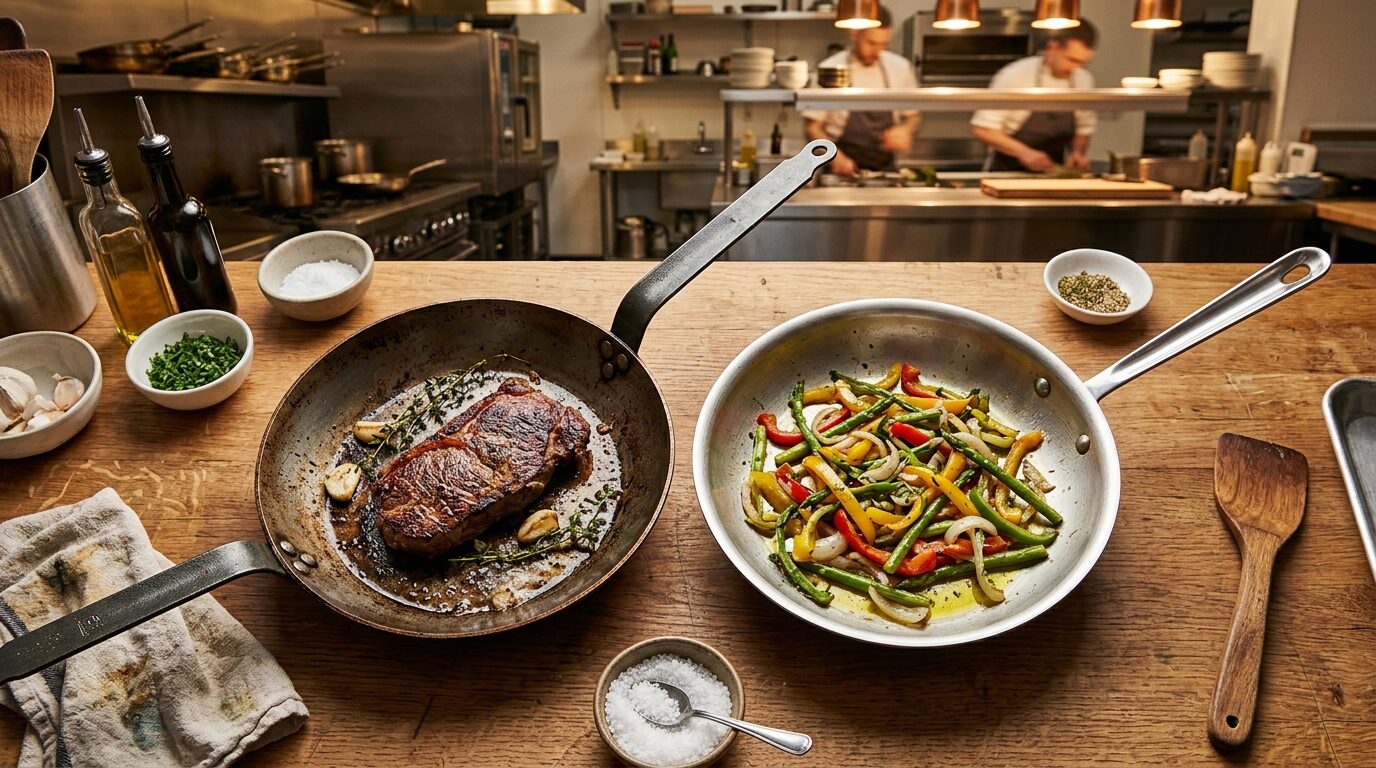
Carbon steel wins for searing, high-heat cooking, and anyone willing to maintain a seasoned surface. Stainless wins for acidic cooking, dishwasher compatibility, and cooks who want zero maintenance. Neither is objectively better. They solve different problems.
Most professional restaurant kitchens use carbon steel for their sauté pans and stainless for their saucepans. That tells you most of what you need to know.
Quick Comparison
| Feature | Carbon Steel | Stainless Steel |
|---|---|---|
| Weight (10-inch pan) | 1.3–1.8 kg (2.8–4 lbs) | 0.9–1.4 kg (2–3 lbs) |
| Seasoning required | Yes | No |
| Nonstick capability | Yes, when well-seasoned | No |
| Acidic food safe | No (strips seasoning) | Yes |
| Dishwasher safe | No | Yes (though hand-wash preferred) |
| Heat conductivity | High | Medium (higher with copper core) |
| Max oven temp | 600°F+ (315°C+) | 500–600°F (260–315°C) |
| Price range | $40–$180 | $30–$300+ |
| Durability | Decades (rust if neglected) | Decades (very low maintenance) |
| Induction compatible | Yes | Yes |
What Carbon Steel Actually Is
Carbon steel is an alloy of iron and carbon - the same materials as cast iron, in different proportions. Cast iron is 2–4% carbon. Carbon steel is 0.5–1.5% carbon. Less carbon means a more malleable metal, which allows carbon steel to be pressed and shaped into thinner pans with sloped sides and lighter total weight than cast iron.
The result is a pan that heats faster than cast iron, responds to heat adjustments more quickly, and weighs 30–40% less - while still developing the same polymerized oil seasoning that makes cast iron’s surface non-stick.
The primary carbon steel brands:
- De Buyer Mineral B - the reference standard. Made in France. Beeswax edge coating for rust protection. The most widely used carbon steel pan in professional kitchens.
- Matfer Bourgeat - also French, more common in culinary school programs. Slightly lighter than De Buyer.
- BK Cookware - Dutch-made, preseasoned from factory, slightly lower price point.
- Lodge Seasoned Carbon Steel - American-made, preseasoned, well-priced at $40–$60.
What Stainless Steel Actually Is
Stainless steel is a steel alloy with a minimum 10.5% chromium content. The chromium creates a passive oxide layer on the surface that resists rust and corrosion without seasoning or special maintenance. This is why stainless steel does not rust, does not react with acid, and can go directly into the dishwasher.
Most quality cookware labeled “stainless steel” is actually a multi-ply construction: stainless on the cooking surface and exterior, with an aluminum or copper core sandwiched between layers. Aluminum conducts heat roughly 10× better than stainless. The core distributes heat evenly across the pan; the stainless surface provides durability and a neutral cooking surface.
The main stainless constructions:
- 3-ply (tri-ply): Stainless / aluminum / stainless. Standard. All-Clad D3, Made In, Tramontina Tri-Ply.
- 5-ply: Multiple alternating layers of stainless and aluminum, sometimes with copper. More even heat distribution, higher price. All-Clad D5, Hestan.
- Disk-bottom: Thick aluminum disk bonded to stainless base. Adequate for most cooking. Common in budget lines.
For a full review of the best stainless sets, see best cookware sets under $200.
Searing Performance
Carbon steel wins here, with a caveat.
A well-seasoned carbon steel pan reaches searing temperature faster than stainless and maintains temperature through the initial protein contact better than most stainless pans. The seasoned surface also means less sticking when the crust develops - proteins release naturally once the Maillard reaction is complete, without the brief “sticking” phase that stainless requires before release.
Stainless steel sears well when preheated correctly. The common failure mode is putting protein in a stainless pan before it is hot enough. Stainless requires a longer preheat than most cooks give it. The “water bead” test works: add a few drops of water to the pan over medium-high heat. When the water forms a single bead that rolls around the surface (Leidenfrost effect), the pan is ready. Protein added at this point browns without sticking.
The verdict: For a steak or a chicken thigh, carbon steel produces a marginally better crust. For a weeknight cook who preheats properly, stainless performs nearly as well and requires no maintenance.
The Maintenance Question
This is where the two materials diverge most sharply.
Carbon Steel Maintenance
Carbon steel requires the same maintenance as cast iron:
- Avoid prolonged exposure to water (rust develops)
- Avoid acidic foods (tomatoes, wine, citrus strip the seasoning)
- After washing, dry completely on a burner over low heat
- Apply a thin coat of oil while warm; wipe off excess
Skip this routine and the pan rusts. Rust is recoverable - scrub with steel wool, re-season - but it is a consequence most cooks would prefer to avoid. For the full care and re-seasoning protocol, see how to care for cast iron, which applies equally to carbon steel.
The seasoning builds over time. A new carbon steel pan is sticky and requires patient development across 5–10 cooking sessions before it releases food readily. Many cooks season the pan in an oven before first use to accelerate the process.
Stainless Steel Maintenance
Hand-wash preferred to preserve the surface, but dishwasher-safe in practice. No seasoning. No rust risk. No reactive surface concern.
The only stainless steel maintenance task: removing stuck-on residue and oil discoloration. Barkeeper’s Friend (oxalic acid powder) removes both in under two minutes. Apply with a damp cloth, rub in circular motions, rinse. The pan looks new.
Stainless steel can develop rainbow discoloration (heat tint) from high-heat cooking. Barkeeper’s Friend removes this completely.
If you want a pan that goes in the dishwasher and requires no attention between uses, stainless is the only answer.
Acidic Cooking
Stainless wins completely. Carbon steel seasoning is dissolved by acid. Simmering a tomato sauce in carbon steel strips the seasoning, potentially imparts a metallic taste to the food, and leaves the surface more vulnerable to rust. This is not a minor limitation - it disqualifies carbon steel from a significant portion of everyday cooking.
Stainless handles wine, tomatoes, citrus, and vinegar-based sauces without any reaction. This is why professional kitchens use stainless saucepans and sauciers alongside carbon steel sauté pans. The two materials are complements, not competitors.
What to Buy First
If you are building a first serious pan collection and can buy only one, the decision is simpler than it sounds.
Buy carbon steel if:
- You cook primarily proteins that benefit from high searing heat
- You are comfortable with a maintenance routine
- You want a pan that builds nonstick properties over time
- You use your oven frequently for finishing dishes
- You are replacing or augmenting a cast iron collection
Buy stainless if:
- You cook a variety of foods including acidic dishes
- You want minimal maintenance
- You share kitchen duties and cannot guarantee the care routine
- You want a pan that performs identically every time without developing a build-up
- You need dishwasher compatibility
The practical answer for most households: Own both. A 10-inch carbon steel for searing proteins, a 3-quart stainless saucier for sauces and anything acidic. These two pans cover 80% of stovetop cooking.
Specific Recommendations
Carbon Steel
- De Buyer Mineral B 11-inch (28 cm) - $65. The standard. Build a proper seasoning on this and it will last a lifetime.
- Matfer Bourgeat 11.875-inch (30 cm) - $55. Slightly lighter. Favored in culinary education.
- Lodge Seasoned Carbon Steel 10-inch (26 cm) - $40. Preseasoned, American-made, the accessible entry point.
Stainless Steel
- All-Clad D3 10-inch (25 cm) Skillet - $120. The reference-grade tri-ply stainless. Welded handle, oven safe to 600°F, made in the US.
- Made In 10-inch (25 cm) Stainless Skillet - $99. 5-ply, polished interior, excellent heat distribution at a slightly lower price.
- Tramontina Tri-Ply 10-inch (25 cm) - $40. Best value-per-performance stainless pan available. Available at Costco, Walmart, and Amazon.